Decision Making for AI-Based Preservation of Cosmic Biodiversity. The Dilemma Between Biocentric and Technocratic Civilizations / Question 19
ASX-48-004-Q19 · Part IV · Interstellar Robotics Technologies · Chapter 8: The Universal Stage
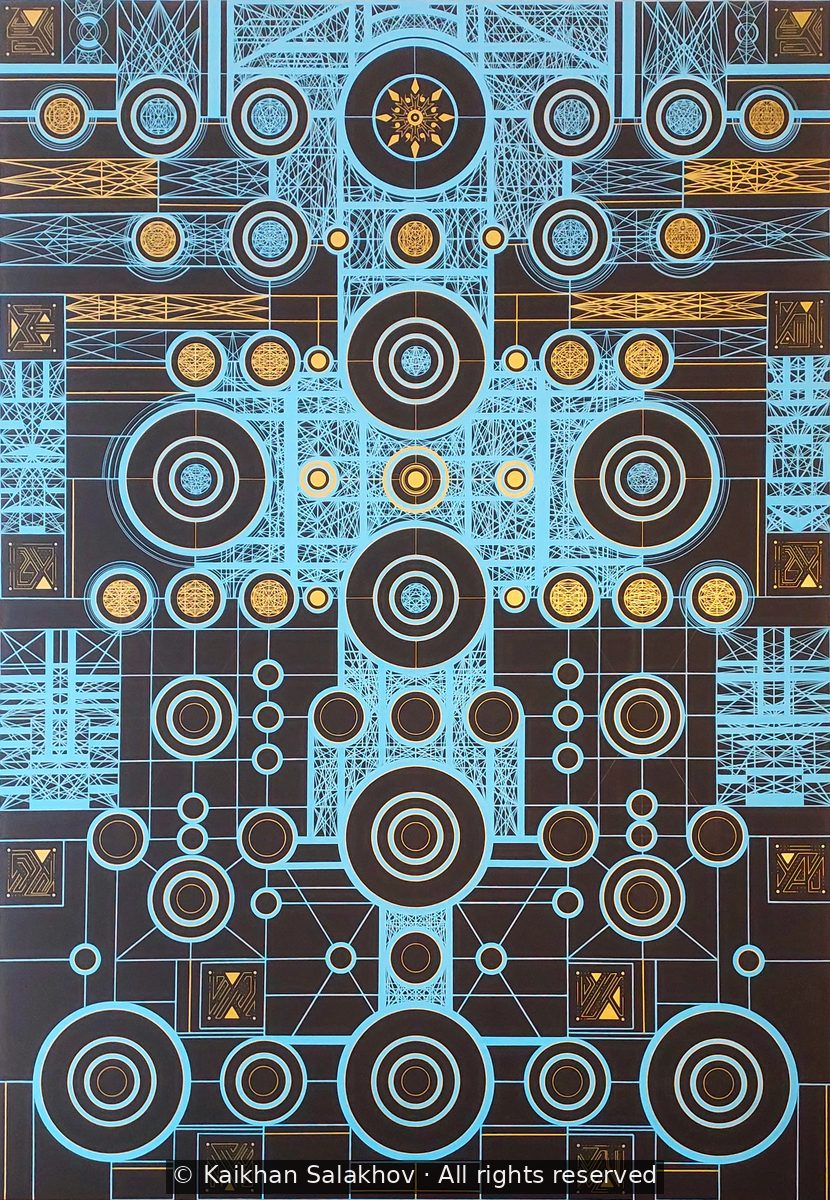
Technologies Across Life Forms
Cooperation, exchange and incompatibility among technical systems shaped by different environments, cognitive architectures and institutions.
Read the full painting meaning →This question examines intergroup conflict. Competing objectives and unequal capabilities can turn disagreement into coercion or organized violence. Its surrounding discussion also concerns cognitive autonomy: external intervention in cognition can undermine an agent’s ability to form or revise its own decisions.
The analytical issue is how these conditions affect the proposed mechanism, technical dependencies, control interfaces, and failure conditions. The node treats the potential dysfunction as an open problem: its identification does not demonstrate that the anticipated outcome will occur or that an assumed technology is feasible.
Main problem
Competing objectives and unequal capabilities can turn disagreement into coercion or organized violence.
Central question
What arrangements could contain escalation while preserving the security of affected groups?
Analytical connections
Technology
For this intergroup conflict problem, technology examines the proposed mechanism, technical dependencies, control interfaces, and failure conditions.
Contact Disposition
For this intergroup conflict problem, contact disposition examines relations between groups, conflict escalation, cooperation, and responses to unfamiliar agents.
Ethics / Moral Consideration
For this intergroup conflict problem, ethics / moral consideration examines consent, exposure to harm, unequal treatment, and the scope of moral protection.
Environmental Systems
For this intergroup conflict problem, environmental systems examines environmental dependencies, unintended ecological effects, and conditions required for habitation.
Cognitive Architecture
For this intergroup conflict problem, cognitive architecture examines information processing, decision formation, shared cognition, and limits of interpretation.
Biology / Substrate
For this intergroup conflict problem, biology / substrate examines substrate-specific needs, compatibility, vulnerability, and the consequences of biological modification.
Resource Allocation / Economy
For this intergroup conflict problem, resource allocation / economy examines ownership, access to scarce inputs, dependency, and incentives affecting allocation.
Worldview / Philosophy
For this intergroup conflict problem, worldview / philosophy examines assumptions about knowledge, identity, reality, and the criteria used to justify conclusions.
Temporality
For this intergroup conflict problem, temporality examines decision horizons, asynchronous experience, institutional duration, and long-term commitments.
Social Structure
For this intergroup conflict problem, social structure examines group membership, social differentiation, cohesion, and the distribution of roles.
Consciousness / Psychology
For this intergroup conflict problem, consciousness / psychology examines subjective experience, identity, agency, and the psychological effects of the scenario.
Religion / Spirituality / Ultimate Meaning
For this intergroup conflict problem, religion / spirituality / ultimate meaning examines belief communities, religious authority, continuity of meaning, and freedom of interpretation.
Original source prose and question wording remain in the book. The summary and central question are analytical restatements; the author’s complete wording remains in the cited source.
ASX positions and scientific context
- P8 scope
- C5 thematic relevance
- C6 thematic relevance
- C position: not established
- Speculative scenario
Physical scope and coordination themes describe fields of inquiry. They do not establish a measured capability or scientific validation.
Cross-domain dependencies
Conditional analytical comparisons; question-level access follows the parent discussion.
Preservation priorities and exclusion
Preservation decisions can privilege selected forms of life when recognition or representation is unequal.
Segregation and concentrated authority can shape which preservation priorities are adopted.
ASX-48-004: Decision Making for AI-Based Preservation of Cosmic Biodiversity. The Dilemma Between Biocentric and Technocratic Civilizations, pp. 420–423; ASX-78-004: Cosmogeopolitics of Manipulation and Segregation. Supremacy in Hyperclusters Against the Fragmentation of Civilizations into Galactic Filaments, pp. 791–792.
Open ASX-78-004Autonomy and control of artificial systems / Ecological intervention and habitation / Knowledge and cultural continuity / Technical and cognitive interoperability / Long-term survival and intervention / Infrastructure and strategic conflict
Delegated machine authority can affect infrastructure, environmental interventions and coercive capability. Accountability, access controls and institutional incentives can also alter how autonomous systems are deployed.
Habitats and life-support systems depend on environmental conditions; engineering and resource extraction can change those conditions. Institutional priorities determine acceptable interventions, whose consequences can then alter settlement viability and social choices.
Continuity depends on storage, interpretation, education and communication. Changes to those systems can alter shared knowledge, while communities and institutions decide which records and practices are preserved or excluded.
Interoperation depends on compatible interfaces and sufficiently shared interpretations. Standards, translation and access arrangements affect cooperation, while biological and cognitive differences can change what a usable interface requires.
Assumptions about long-term environmental change influence preservation strategies and resource commitments. These scenarios compare choices under uncertain boundary conditions; proposed control over universal or multiversal processes is not established engineering.
Infrastructure can become both a strategic asset and a target. Conflict may disrupt energy, transport or communications, while dependence on those services can be exploited to constrain decisions.
ASX-48-004: Decision Making for AI-Based Preservation of Cosmic Biodiversity. The Dilemma Between Biocentric and Technocratic Civilizations, pp. 420–423; ASX-58-001: Astral Space Exploration. The Fundamentals of Cosmocybernetics. General Management, Mind, and Messages, pp. 544–550.
Open ASX-58-001Autonomy and control of artificial systems / Ecological intervention and habitation / Knowledge and cultural continuity / Technical and cognitive interoperability / Long-term survival and intervention / Infrastructure and strategic conflict
Delegated machine authority can affect infrastructure, environmental interventions and coercive capability. Accountability, access controls and institutional incentives can also alter how autonomous systems are deployed.
Habitats and life-support systems depend on environmental conditions; engineering and resource extraction can change those conditions. Institutional priorities determine acceptable interventions, whose consequences can then alter settlement viability and social choices.
Continuity depends on storage, interpretation, education and communication. Changes to those systems can alter shared knowledge, while communities and institutions decide which records and practices are preserved or excluded.
Interoperation depends on compatible interfaces and sufficiently shared interpretations. Standards, translation and access arrangements affect cooperation, while biological and cognitive differences can change what a usable interface requires.
Assumptions about long-term environmental change influence preservation strategies and resource commitments. These scenarios compare choices under uncertain boundary conditions; proposed control over universal or multiversal processes is not established engineering.
Infrastructure can become both a strategic asset and a target. Conflict may disrupt energy, transport or communications, while dependence on those services can be exploited to constrain decisions.
ASX-48-004: Decision Making for AI-Based Preservation of Cosmic Biodiversity. The Dilemma Between Biocentric and Technocratic Civilizations, pp. 420–423; ASX-68-001: Infrastructure Supercluster Interconnectivity via Galactic Filaments, pp. 656–660.
Open ASX-68-001Autonomy and control of artificial systems / Ecological intervention and habitation / Knowledge and cultural continuity / Technical and cognitive interoperability / Long-term survival and intervention / Infrastructure and strategic conflict
Delegated machine authority can affect infrastructure, environmental interventions and coercive capability. Accountability, access controls and institutional incentives can also alter how autonomous systems are deployed.
Habitats and life-support systems depend on environmental conditions; engineering and resource extraction can change those conditions. Institutional priorities determine acceptable interventions, whose consequences can then alter settlement viability and social choices.
Continuity depends on storage, interpretation, education and communication. Changes to those systems can alter shared knowledge, while communities and institutions decide which records and practices are preserved or excluded.
Interoperation depends on compatible interfaces and sufficiently shared interpretations. Standards, translation and access arrangements affect cooperation, while biological and cognitive differences can change what a usable interface requires.
Assumptions about long-term environmental change influence preservation strategies and resource commitments. These scenarios compare choices under uncertain boundary conditions; proposed control over universal or multiversal processes is not established engineering.
Infrastructure can become both a strategic asset and a target. Conflict may disrupt energy, transport or communications, while dependence on those services can be exploited to constrain decisions.
ASX-48-004: Decision Making for AI-Based Preservation of Cosmic Biodiversity. The Dilemma Between Biocentric and Technocratic Civilizations, pp. 420–423; ASX-78-001: Cosmogeopolitical Management of Galactic Filaments is Supercluster Interaction, pp. 786–788.
Open ASX-78-001Ecological intervention and habitation / Knowledge and cultural continuity / Technical and cognitive interoperability / Long-term survival and intervention / Infrastructure and strategic conflict
Habitats and life-support systems depend on environmental conditions; engineering and resource extraction can change those conditions. Institutional priorities determine acceptable interventions, whose consequences can then alter settlement viability and social choices.
Continuity depends on storage, interpretation, education and communication. Changes to those systems can alter shared knowledge, while communities and institutions decide which records and practices are preserved or excluded.
Interoperation depends on compatible interfaces and sufficiently shared interpretations. Standards, translation and access arrangements affect cooperation, while biological and cognitive differences can change what a usable interface requires.
Assumptions about long-term environmental change influence preservation strategies and resource commitments. These scenarios compare choices under uncertain boundary conditions; proposed control over universal or multiversal processes is not established engineering.
Infrastructure can become both a strategic asset and a target. Conflict may disrupt energy, transport or communications, while dependence on those services can be exploited to constrain decisions.
ASX-48-004: Decision Making for AI-Based Preservation of Cosmic Biodiversity. The Dilemma Between Biocentric and Technocratic Civilizations, pp. 420–423; ASX-58-002: Astral Space Exploration. The Fundamentals of Cosmocybernetics. Galactical Filaments. Quantum and Cosmic Engineering. Galactical Drifts, Voids, and the Future of the Universe, pp. 550–555.
Open ASX-58-002Ecological intervention and habitation / Knowledge and cultural continuity / Long-term survival and intervention / Infrastructure and strategic conflict
Habitats and life-support systems depend on environmental conditions; engineering and resource extraction can change those conditions. Institutional priorities determine acceptable interventions, whose consequences can then alter settlement viability and social choices.
Continuity depends on storage, interpretation, education and communication. Changes to those systems can alter shared knowledge, while communities and institutions decide which records and practices are preserved or excluded.
Assumptions about long-term environmental change influence preservation strategies and resource commitments. These scenarios compare choices under uncertain boundary conditions; proposed control over universal or multiversal processes is not established engineering.
Infrastructure can become both a strategic asset and a target. Conflict may disrupt energy, transport or communications, while dependence on those services can be exploited to constrain decisions.
ASX-28-019: Muiltiverse Wars. Wars Across the Unending Concern Realms, pp. 203–204; ASX-48-004: Decision Making for AI-Based Preservation of Cosmic Biodiversity. The Dilemma Between Biocentric and Technocratic Civilizations, pp. 420–423.
Open ASX-28-019Autonomy and control of artificial systems / Robotics and infrastructure maintenance / Infrastructure and strategic conflict
Delegated machine authority can affect infrastructure, environmental interventions and coercive capability. Accountability, access controls and institutional incentives can also alter how autonomous systems are deployed.
Infrastructure can depend on autonomous construction and maintenance, while robotics depends on power, materials, communication and accessible repair facilities. This is a conditional operational dependency, not evidence that a proposed megastructure can be constructed.
Infrastructure can become both a strategic asset and a target. Conflict may disrupt energy, transport or communications, while dependence on those services can be exploited to constrain decisions.
ASX-48-004: Decision Making for AI-Based Preservation of Cosmic Biodiversity. The Dilemma Between Biocentric and Technocratic Civilizations, pp. 420–423; ASX-78-010: Multiversal Hierarchy. Architectural Segregation and Abduction of Universes in a Cosmogeopolitical Scene, pp. 801–803.
Open ASX-78-010Knowledge and cultural continuity / Technical and cognitive interoperability / Long-term survival and intervention / Infrastructure and strategic conflict
Continuity depends on storage, interpretation, education and communication. Changes to those systems can alter shared knowledge, while communities and institutions decide which records and practices are preserved or excluded.
Interoperation depends on compatible interfaces and sufficiently shared interpretations. Standards, translation and access arrangements affect cooperation, while biological and cognitive differences can change what a usable interface requires.
Assumptions about long-term environmental change influence preservation strategies and resource commitments. These scenarios compare choices under uncertain boundary conditions; proposed control over universal or multiversal processes is not established engineering.
Infrastructure can become both a strategic asset and a target. Conflict may disrupt energy, transport or communications, while dependence on those services can be exploited to constrain decisions.
ASX-48-004: Decision Making for AI-Based Preservation of Cosmic Biodiversity. The Dilemma Between Biocentric and Technocratic Civilizations, pp. 420–423; ASX-68-002: Xenoanthropology and Cosmocentric Consciousness. Beyond Species-Centric Perspectives, pp. 660–663.
Open ASX-68-002Autonomy and control of artificial systems / Ecological intervention and habitation / Long-term survival and intervention / Infrastructure and strategic conflict
Delegated machine authority can affect infrastructure, environmental interventions and coercive capability. Accountability, access controls and institutional incentives can also alter how autonomous systems are deployed.
Habitats and life-support systems depend on environmental conditions; engineering and resource extraction can change those conditions. Institutional priorities determine acceptable interventions, whose consequences can then alter settlement viability and social choices.
Assumptions about long-term environmental change influence preservation strategies and resource commitments. These scenarios compare choices under uncertain boundary conditions; proposed control over universal or multiversal processes is not established engineering.
Infrastructure can become both a strategic asset and a target. Conflict may disrupt energy, transport or communications, while dependence on those services can be exploited to constrain decisions.
ASX-28-005: Quantum Replicators and Constructors. Construction of the Cosmos Layer by Layer from the Quantum Level, pp. 189–189; ASX-48-004: Decision Making for AI-Based Preservation of Cosmic Biodiversity. The Dilemma Between Biocentric and Technocratic Civilizations, pp. 420–423.
Open ASX-28-005Autonomy and control of artificial systems / Knowledge and cultural continuity / Long-term survival and intervention
Delegated machine authority can affect infrastructure, environmental interventions and coercive capability. Accountability, access controls and institutional incentives can also alter how autonomous systems are deployed.
Continuity depends on storage, interpretation, education and communication. Changes to those systems can alter shared knowledge, while communities and institutions decide which records and practices are preserved or excluded.
Assumptions about long-term environmental change influence preservation strategies and resource commitments. These scenarios compare choices under uncertain boundary conditions; proposed control over universal or multiversal processes is not established engineering.
ASX-18-011: Repetition of the Cosmic Cycle in Multiversal Development, pp. 71–72; ASX-48-004: Decision Making for AI-Based Preservation of Cosmic Biodiversity. The Dilemma Between Biocentric and Technocratic Civilizations, pp. 420–423.
Open ASX-18-011Knowledge and cultural continuity / Long-term survival and intervention / Infrastructure and strategic conflict
Continuity depends on storage, interpretation, education and communication. Changes to those systems can alter shared knowledge, while communities and institutions decide which records and practices are preserved or excluded.
Assumptions about long-term environmental change influence preservation strategies and resource commitments. These scenarios compare choices under uncertain boundary conditions; proposed control over universal or multiversal processes is not established engineering.
Infrastructure can become both a strategic asset and a target. Conflict may disrupt energy, transport or communications, while dependence on those services can be exploited to constrain decisions.
ASX-18-009: The Limits of Spiritual Authority and the Opportunity for Cosmic Splits, pp. 69–70; ASX-48-004: Decision Making for AI-Based Preservation of Cosmic Biodiversity. The Dilemma Between Biocentric and Technocratic Civilizations, pp. 420–423.
Open ASX-18-009Associated paintings
- Astral SpaceX: The Cosmic Engineer
- Astral SpaceX: The Cosmic A.I
- Astral SpaceX: The Fabric of Space
- Astral SpaceX: The Multiverse Generator
- Technologies Across Life Forms
Source organization
- part of: ASX-48-004
Citation
Kaikhan Salakhov (2024). Astral Space Exploration: The Cosmic Renaissance: The Fundamental Principles of Cosmocybernetics. Part IV, “Astral Space Exploration Grid: Interstellar Robotics Technologies Through Stages of Development”; Chapter 8, “The Universal Stage”; discussion: “Decision Making for AI-Based Preservation of Cosmic Biodiversity. The Dilemma Between Biocentric and Technocratic Civilizations”; question 19, p. 423. Page references follow the supplied 852-page edition; pagination in other editions may differ. Library reference: ASX-48-004-Q19. https://www.asxgrid.app/library/records/ASX-48-004-Q19.html
Page references follow the supplied 852-page edition; pagination in other editions may differ..
Book publication: . Map created: . Map revised: .