Ghost in the Shell and the Ethics of Digital Consciousness
ASX-32-007 · Part III · Interstellar Simulation Technologies · Chapter 2: The Planetary Stage
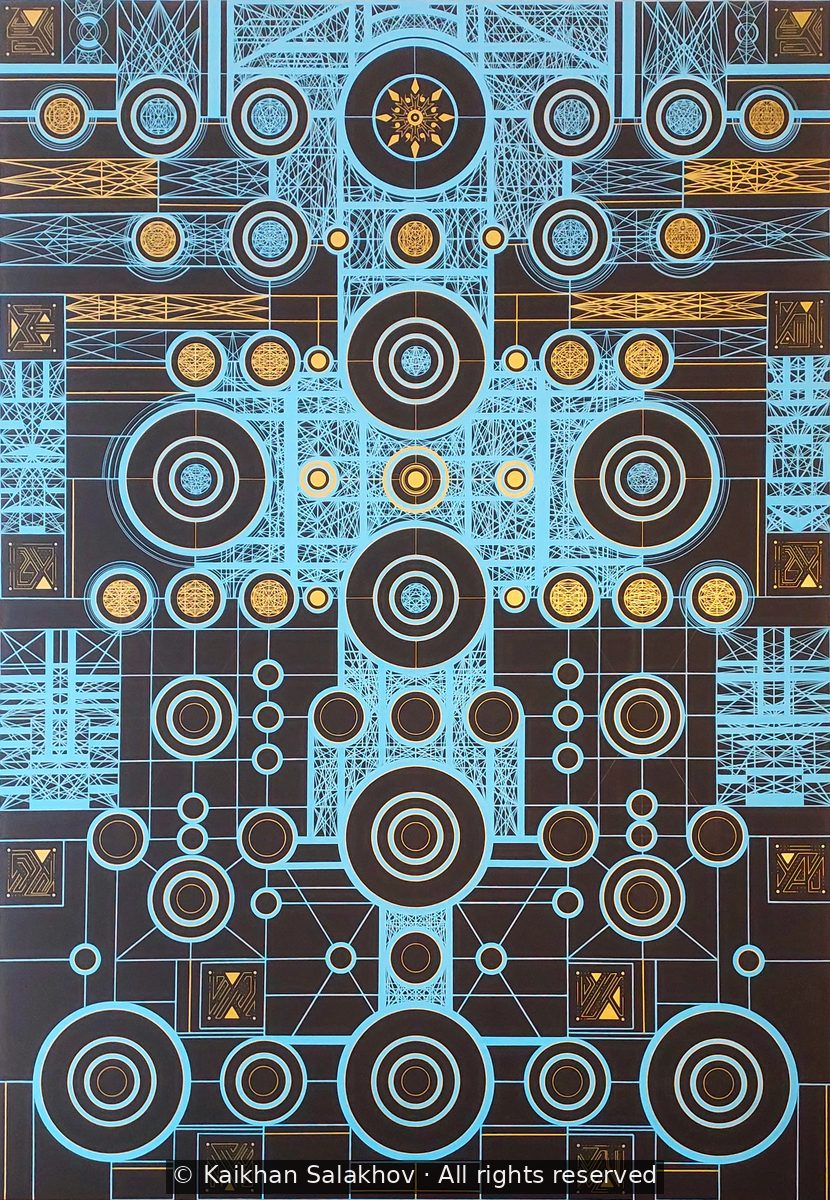
Technologies Across Life Forms
Cooperation, exchange and incompatibility among technical systems shaped by different environments, cognitive architectures and institutions.
Read the full painting meaning →This discussion examines conscious experience. The discussion depends on how experience is attributed to beings whose internal states may be inaccessible. Its surrounding discussion also concerns identity continuity: alteration, duplication, or transfer of an agent can make persistence of identity and responsibility ambiguous.
The analytical issue is how these conditions affect subjective experience, identity, agency, and the psychological effects of the scenario. The node treats the potential dysfunction as an open problem: its identification does not demonstrate that the anticipated outcome will occur or that an assumed technology is feasible.
Main problem
The discussion depends on how experience is attributed to beings whose internal states may be inaccessible.
Central question
What evidence and conceptual criteria would justify attributing experience to the entities considered?
Analytical connections
Consciousness / Psychology
For this conscious experience problem, consciousness / psychology examines subjective experience, identity, agency, and the psychological effects of the scenario.
Ethics / Moral Consideration
For this conscious experience problem, ethics / moral consideration examines consent, exposure to harm, unequal treatment, and the scope of moral protection.
Technology
For this conscious experience problem, technology examines the proposed mechanism, technical dependencies, control interfaces, and failure conditions.
Social Structure
For this conscious experience problem, social structure examines group membership, social differentiation, cohesion, and the distribution of roles.
Religion / Spirituality / Ultimate Meaning
For this conscious experience problem, religion / spirituality / ultimate meaning examines belief communities, religious authority, continuity of meaning, and freedom of interpretation.
Original source prose and question wording remain in the book. The summary and central question are analytical restatements; the author’s complete wording remains in the cited source.
ASX positions and scientific context
- P1 scope
- P2 scope
- C position: not established
- Mechanism unresolved
Physical scope and coordination themes describe fields of inquiry. They do not establish a measured capability or scientific validation.
Cross-domain dependencies
Conditional analytical comparisons; question-level access follows the parent discussion.
Knowledge and cultural continuity / Embodiment, identity and recognition / Technical and cognitive interoperability
Continuity depends on storage, interpretation, education and communication. Changes to those systems can alter shared knowledge, while communities and institutions decide which records and practices are preserved or excluded.
Changes in embodiment, cognition or reproduction can challenge categories of identity and agency. Recognition rules and cultural expectations can then constrain access to enhancement, membership and protection. Unfamiliarity alone is not evidence of lesser moral status.
Interoperation depends on compatible interfaces and sufficiently shared interpretations. Standards, translation and access arrangements affect cooperation, while biological and cognitive differences can change what a usable interface requires.
ASX-32-007: Ghost in the Shell and the Ethics of Digital Consciousness, pp. 225–226; ASX-72-001: Emergent Divergent Stellar Identities, pp. 682–686.
Open ASX-72-001Knowledge and cultural continuity / Embodiment, identity and recognition
Continuity depends on storage, interpretation, education and communication. Changes to those systems can alter shared knowledge, while communities and institutions decide which records and practices are preserved or excluded.
Changes in embodiment, cognition or reproduction can challenge categories of identity and agency. Recognition rules and cultural expectations can then constrain access to enhancement, membership and protection. Unfamiliarity alone is not evidence of lesser moral status.
ASX-22-032: Cultural Identity and Architectural Division, pp. 97–97; ASX-32-007: Ghost in the Shell and the Ethics of Digital Consciousness, pp. 225–226.
Open ASX-22-032Knowledge and cultural continuity / Embodiment, identity and recognition / Technical and cognitive interoperability
Continuity depends on storage, interpretation, education and communication. Changes to those systems can alter shared knowledge, while communities and institutions decide which records and practices are preserved or excluded.
Changes in embodiment, cognition or reproduction can challenge categories of identity and agency. Recognition rules and cultural expectations can then constrain access to enhancement, membership and protection. Unfamiliarity alone is not evidence of lesser moral status.
Interoperation depends on compatible interfaces and sufficiently shared interpretations. Standards, translation and access arrangements affect cooperation, while biological and cognitive differences can change what a usable interface requires.
ASX-32-007: Ghost in the Shell and the Ethics of Digital Consciousness, pp. 225–226; ASX-52-001: Unaware of Levels of Awareness. Implications for the Planetary Level of Space Exploration, pp. 439–443.
Open ASX-52-001Knowledge and cultural continuity / Embodiment, identity and recognition / Technical and cognitive interoperability
Continuity depends on storage, interpretation, education and communication. Changes to those systems can alter shared knowledge, while communities and institutions decide which records and practices are preserved or excluded.
Changes in embodiment, cognition or reproduction can challenge categories of identity and agency. Recognition rules and cultural expectations can then constrain access to enhancement, membership and protection. Unfamiliarity alone is not evidence of lesser moral status.
Interoperation depends on compatible interfaces and sufficiently shared interpretations. Standards, translation and access arrangements affect cooperation, while biological and cognitive differences can change what a usable interface requires.
ASX-32-007: Ghost in the Shell and the Ethics of Digital Consciousness, pp. 225–226; ASX-52-006: Surveillance and Control in the Solar System. The Dark Potential of Space-Based Dystopian Governance, pp. 450–452.
Open ASX-52-006Knowledge and cultural continuity / Embodiment, identity and recognition / Technical and cognitive interoperability
Continuity depends on storage, interpretation, education and communication. Changes to those systems can alter shared knowledge, while communities and institutions decide which records and practices are preserved or excluded.
Changes in embodiment, cognition or reproduction can challenge categories of identity and agency. Recognition rules and cultural expectations can then constrain access to enhancement, membership and protection. Unfamiliarity alone is not evidence of lesser moral status.
Interoperation depends on compatible interfaces and sufficiently shared interpretations. Standards, translation and access arrangements affect cooperation, while biological and cognitive differences can change what a usable interface requires.
ASX-32-007: Ghost in the Shell and the Ethics of Digital Consciousness, pp. 225–226; ASX-72-002: Planetary Hierarchies and Cosmic Sovereignty. The Earth’s Claim to Dominion in Contrast to Emerging Free Stellar Personalities, pp. 687–690.
Open ASX-72-002Knowledge and cultural continuity / Embodiment, identity and recognition
Continuity depends on storage, interpretation, education and communication. Changes to those systems can alter shared knowledge, while communities and institutions decide which records and practices are preserved or excluded.
Changes in embodiment, cognition or reproduction can challenge categories of identity and agency. Recognition rules and cultural expectations can then constrain access to enhancement, membership and protection. Unfamiliarity alone is not evidence of lesser moral status.
ASX-32-007: Ghost in the Shell and the Ethics of Digital Consciousness, pp. 225–226; ASX-42-017: Technocentrists and Biomechanicals. Singularity AI vs. Biomechanical AI in a World with Biocentrists Caught in the War, pp. 304–305.
Open ASX-42-017Embodiment, identity and recognition / Technical and cognitive interoperability
Changes in embodiment, cognition or reproduction can challenge categories of identity and agency. Recognition rules and cultural expectations can then constrain access to enhancement, membership and protection. Unfamiliarity alone is not evidence of lesser moral status.
Interoperation depends on compatible interfaces and sufficiently shared interpretations. Standards, translation and access arrangements affect cooperation, while biological and cognitive differences can change what a usable interface requires.
ASX-32-007: Ghost in the Shell and the Ethics of Digital Consciousness, pp. 225–226; ASX-42-016: How Biomechanical AI Emerged: AI Played with Protein Networks and Integrated into the Human Brain, pp. 303–304.
Open ASX-42-016Embodiment, identity and recognition / Technical and cognitive interoperability
Changes in embodiment, cognition or reproduction can challenge categories of identity and agency. Recognition rules and cultural expectations can then constrain access to enhancement, membership and protection. Unfamiliarity alone is not evidence of lesser moral status.
Interoperation depends on compatible interfaces and sufficiently shared interpretations. Standards, translation and access arrangements affect cooperation, while biological and cognitive differences can change what a usable interface requires.
ASX-32-007: Ghost in the Shell and the Ethics of Digital Consciousness, pp. 225–226; ASX-52-003: No Human Flag. The Fragmented Approach to Human Presence in Space, pp. 445–447.
Open ASX-52-003Associated paintings
- Astral SpaceX: The Divine Matrix
- Technologies Across Life Forms
- Spirituality Across Life Forms
- Ethics Across Life Forms
Source organization
- chapter context: CTX-32
Citation
Kaikhan Salakhov (2024). Astral Space Exploration: The Cosmic Renaissance: The Fundamental Principles of Cosmocybernetics. Part III, “Astral Space Exploration Grid: Interstellar Simulation Technologies Through Stages of Development”; Chapter 2, “The Planetary Stage”; discussion: “Ghost in the Shell and the Ethics of Digital Consciousness”, pp. 225–226. Page references follow the supplied 852-page edition; pagination in other editions may differ. Library reference: ASX-32-007. https://www.asxgrid.app/library/records/ASX-32-007.html
Page references follow the supplied 852-page edition; pagination in other editions may differ..
Book publication: . Map created: . Map revised: .